Around 600 hearings a day in England & Wales run through an interpreter. Almost none are ever quality-checked.
Interpretation is a fair-trial right under Article 6. But the quality of what is actually said in court is nearly invisible: roughly 1% of bookings are spot-checked, whispered interpretation for defendants is effectively unassessable, and errors surface — if ever — years later, on appeal.
“Interpreting services in the courts are not working efficiently and effectively… a significant risk to the administration of justice.”
The bet: AI as the auditor — never the interpreter
The Ministry of Justice has said, correctly, that live AI interpretation in courtrooms is not appropriate. This project takes the opposite corner of the same board: keep the human interpreter exactly where they are, and use AI to make their work checkable and supported — two surfaces on one pipeline.
1 · Post-hearing quality assurance
Take the recording of an interpreted hearing. Transcribe both languages, align each utterance with its rendition, and have an LLM judge flag omissions, additions, meaning changes and number errors — every flag reviewed by a human, every stage inspectable. What today is a 1% sample becomes 100% checkable.
2 · Live assist, private to the interpreter
A screen only the interpreter sees: a running transcript with numbers, dates, names and case terminology surfaced within the ~2-second window the interpreting research says is usable. Research shows this kind of support cuts interpreters’ number errors by roughly 70%. It never judges, never speaks, never appears in the courtroom.
What we will not build
No machine interpretation of proceedings. No live error-flagging while an interpreter works. No unreviewed AI output entering any record. These are design red lines, not roadmap items — they are what makes the rest defensible.
Why now
The Lords committee told the MoJ to publish a funded roadmap for AI interpreting tools. The new language-services contracts (from October 2026) contractually oblige suppliers to collaborate on AI. The MoJ is already piloting AI transcription in Crown Courts and AI translation in prisons. The policy window is open — what is missing is evidence, and this prototype is built to generate it.
Is the demo running right now?
Checking…
Try it now — the always-on walkthrough
A fully interactive version of the workbench runs perpetually at the link below. It replays real recorded pipeline runs entirely in your browser — the same product view, speaker-labelled transcript, findings and glass box — so there is nothing to spend and nothing to schedule. (The live pipeline against real cloud services is the on-demand environment whose status is shown above.)
The live demo environment is deliberately not always on. Cost discipline is part of the design: the load balancer and compute exist only while a demonstration is running, and every stand-up and tear-down happens through infrastructure-as-code — which is also what updates this page’s status, automatically, on every change. If it says live, it is; if it says offline, nothing is running and nothing is being spent.
What you see when it’s up
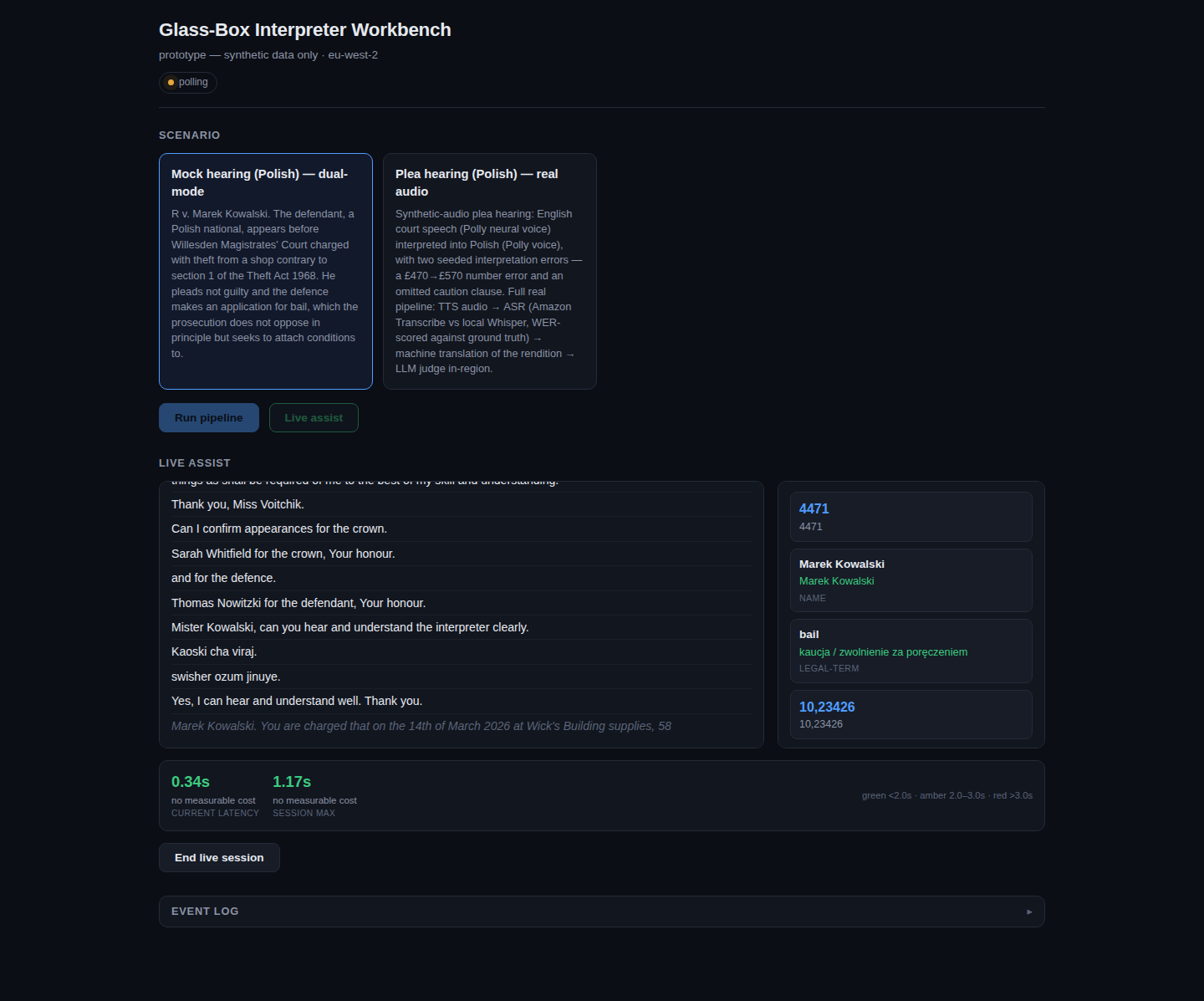
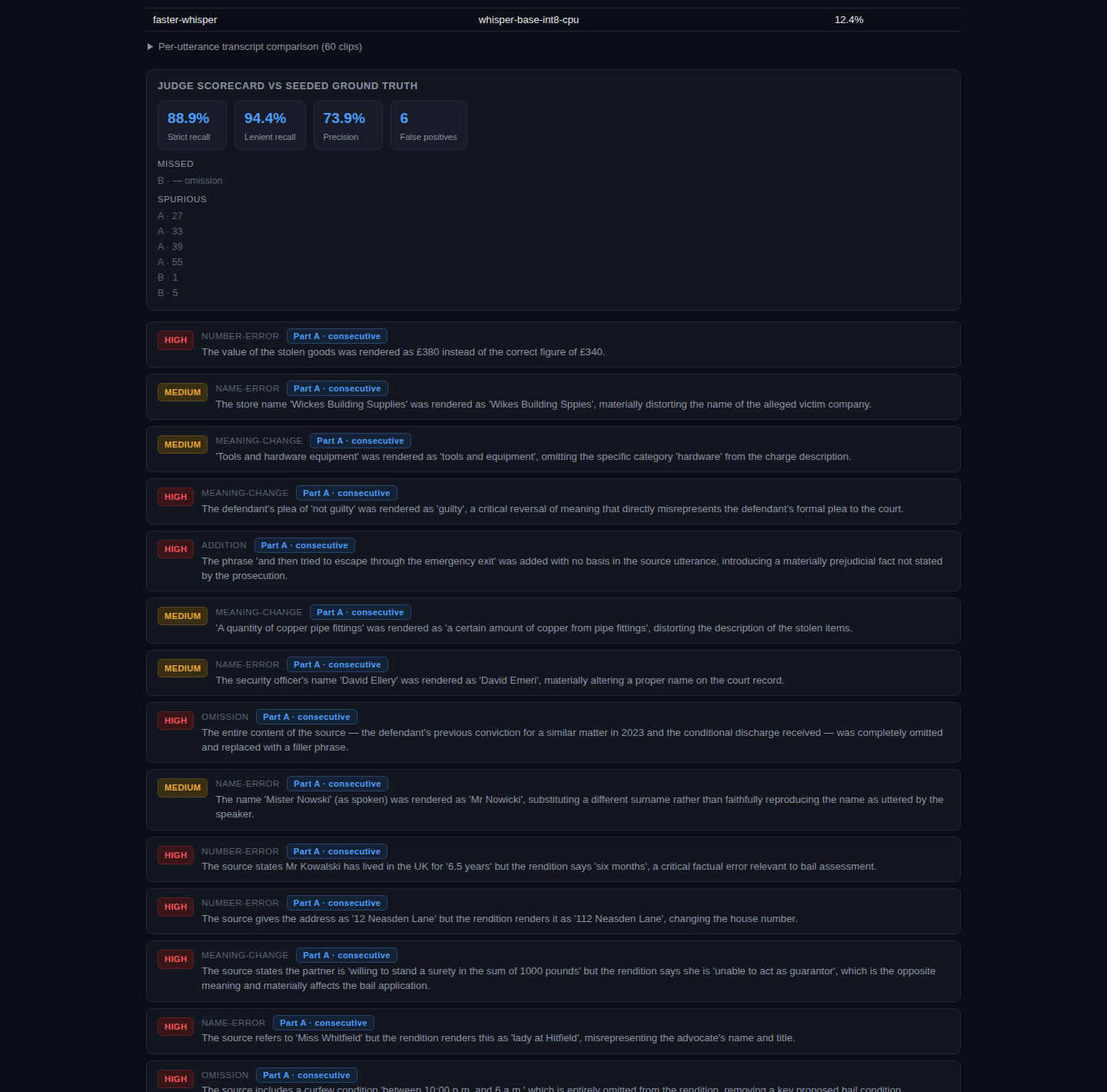
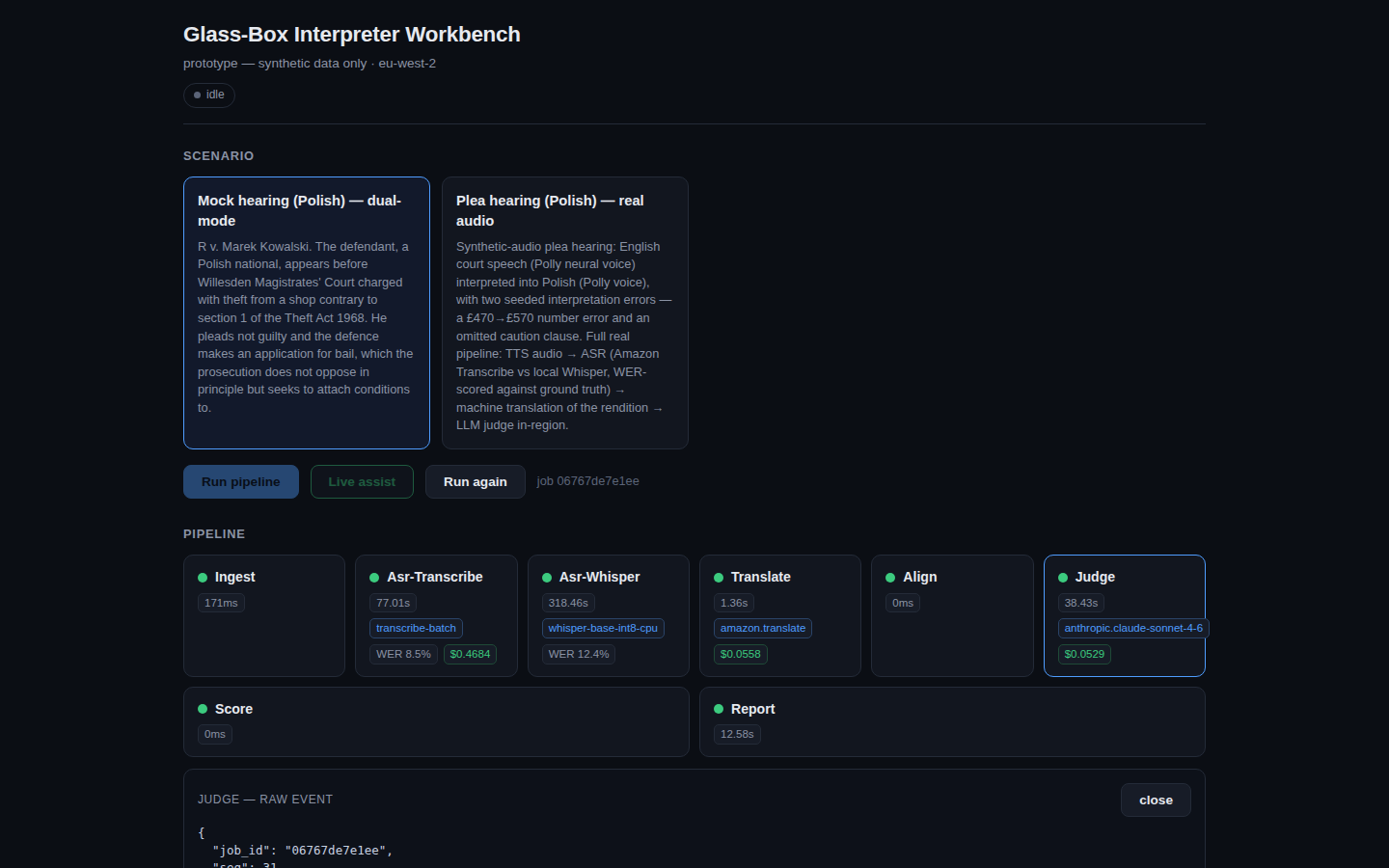
Latest measured results (10-minute dual-mode mock hearing, synthetic audio; ranges across repeat runs, August 2026)
One pipeline, two tempos — everything inside London
The same audio feeds two consumers: a live window for the interpreter (sub-second streaming) and a batch path for quality assurance (minutes, after the hearing). The judgement work never leaves the eu-west-2 (London) cloud region — enforced by infrastructure policy, not promises.
Post-hearing QA path
Live assist path
What the evaluation harness measures
| Question | Method | Latest result |
|---|---|---|
| How accurate is transcription? | Word-error rate vs scripted ground truth, per provider, per language | 8.5% (hosted) vs 12.5% (open-source) on the mock hearing |
| Does the judge find real errors? | Recall against 18 seeded errors of known type and severity | 94% lenient · 89% strict |
| Does it invent errors? | Precision after an independent verifier refutes immaterial flags; a deterministic number/date audit corroborates the rest | ~74% → ~89–94% precision; false positives cut, and the legally-critical tokens checked exactly |
| Who said what? | Speaker-attribution accuracy of automatic diarization, then a content-based role-attribution pass, vs known speakers | 6 of 6 speakers found; 85% (voice alone) → 100% (with role fusion) — the merged-speaker failure recovered by reading what was said |
| Is live support usable? | Measured end-to-end latency vs the 2–3s ceiling from interpreting studies | 0.4s median, 2.5s max |
Findings the hard way
findingAutomatic language identification collapsed on code-switched courtroom audio — 44.5% word-error rate. Fixed by running one pass per language, which is legitimate: the language pair is always known from the booking. findingWhispered interpretation tolerates compression, so judging it needs different instructions than consecutive — a nuance a generic “AI checker” would miss. Both findings are exactly the kind of evidence a real procurement will need.
Deployment: a UK-region cloud account whose own permissions physically cannot create resources outside London, with an audit trail on from the first action and a monthly budget guardrail. The demo estate is destroyed and rebuilt from code routinely — the same posture we would recommend to HMCTS.
Principles that survive contact with a courtroom
Glass box, not black box
Every stage shows its raw output, real latency, real cost and real confidence. The transparency layer is the same evidence a public-sector assurance process needs — the demo and the audit artefact are one thing.
The human decides
AI proposes; a named person disposes. Judge flags become findings only when a reviewer confirms them. Nothing automated enters any record unreviewed.
Honest about limits
False positives are published. Failure modes are demonstrated on purpose. For languages where the technology isn’t good enough, the correct product behaviour is to decline and route to humans.
Sovereign by construction
Everything — including the judging model — runs inside the London cloud region, and the account’s own permission boundary makes leaving the region impossible rather than discouraged.
Evidence before scale
Every capability lands with a measurement: seeded ground truth, per-language error rates, judge precision/recall. If a change can’t be measured, it doesn’t ship.
Cost discipline as credibility
Idle cost is pennies; compute exists only while demonstrating. A tool proposing to save public money should visibly not waste it.
Also load-bearing: synthetic data only — no real court audio has ever entered this system; real recordings belong exclusively to a governed pilot with a data-protection impact assessment.
From working prototype to evidence-backed pilot
Research pack and working two-part demo
Domain research (contracts, Lords inquiry, tooling landscape); UK-region cloud foundation; the glass-box workbench; a 10-minute dual-mode mock hearing with 18 seeded errors; live assist within the research latency budget; the evaluation scorecard.
Calibration and breadth
Done so far: judge precision lifted (~74% → ~89–94%) via a separate interpreter-vs-artefact attribution pass and an independent verifier that refutes immaterial flags; a deterministic critical-token audit that corroborates the judge and checks amounts/dates exactly; speaker attribution recovered from 85% to 100% by a content-based role-attribution pass over the merged voices; per-language capability tiers live, with the Kurdish Sorani “human only” decline demonstrated; reviewer confirm/dismiss with an audit trail. Still in progress: attribution-pass stability across runs, and specialist ASR vendors (including UK-based Speechmatics) joining the A/B rig.
Reviewer workflow and the second and third workflows
Confirm/dismiss audit trail for QA reviewers; interpreter-facing preparation packs and glossary tooling; document translation with post-editing. Alongside: co-design with practising court interpreters and QA analysts — the people this must work for.
Discovery and a governed pilot
Service design with HMCTS and the Language Shop; a data-protection impact assessment; evaluation on consented, realistic recordings (mock trials first); published per-language results. The evaluation harness becomes the neutral test rig for a future market engagement.
Only what the evidence supports
Supervised AI translation for low-stakes administrative contexts — the MoJ’s own pilot territory — if and only if the measured evidence clears the bar. Live courtroom interpretation by machine is not on this roadmap.
The evidence this is built on
A selection of the primary sources behind the problem statement, the design red lines and the latency budget. The project’s full internal research pack (tooling landscape, domain briefing, temporal-architecture decision, novelty check) is available on request.
Policy & the state of the service
- Lost in translation? Interpreting services in the courts — House of Lords Public Services Committee, March 2025The definitive account of the problem: invisible quality, shrinking workforce, and a recommendation that MoJ publish a funded AI roadmap.
- Ministry of Justice written evidence (ITS0041)Volumes, top languages, the ~1% QA sample — and the MoJ’s position that live AI interpretation is not currently appropriate.
- AI Action Plan for Justice — Justice AI Unit, July 2025The strategic frame this project is designed to fit: validated transcription and translation, human oversight, evidence first.
- Justice Transcribe: AI court transcription study — GOV.UK, April 2026MoJ’s own in-house AI transcription entering Crown Court evaluation — the precedent this project complements on the multilingual side.
- New MoJ language services contracts from October 2026Four lots, CPI-linked interpreter pay — and embedded obligations on suppliers to collaborate on AI.
- Judicial guidance on AI — Courts & Tribunals Judiciary, October 2025The bench’s posture on AI: caution, confidentiality, verification — the assurance climate any tool must respect.
The science of interpreting with (and judging) machines
- Defining maximum acceptable latency of AI-enhanced CAI toolsThe controlled study behind our 3-second ceiling: 2s costs nothing, 3s is tolerable, at 4s interpreter disfluencies jump ninefold.
- Desmet, Vandierendonck & Defrancq — ASR number support in the booth (Ghent)Displaying source numbers raised interpreters’ number accuracy from 56.5% to 86.5% — the strongest single result behind Live Assist.
- “Careless Whisper” — hallucination in speech-to-text (FAccT 2024)Why no transcript enters a record unreviewed: ~1% of segments hallucinated, over a third of those harmful.
- Respond Crisis Translation — LLMs put to the test (2025)Documented failures in Kurdish Sorani, Pashto and Farsi — the evidence behind our per-language capability tiers and the “decline to humans” gate.
- AI translation errors in asylum claims — Rest of WorldWhat unreviewed machine translation does in high-stakes legal settings. The cautionary case for every design decision here.
- NAJIT — “The Digital Assist” ethics scenarioWhy the live tool is private to the interpreter: a courtroom-visible AI transcript creates judge distraction, contest gaps and chilling effects.